I am a PhD candidate at Delft University of Technology in the Data-Intensive Systems (DIS) group, supervised by Dr. Kubilay Atasu. My research focuses on advancing Graph Neural Networks, particularly for complex graph structures such as multigraphs, motivated in large part by applications in financial crime detection.
Before joining TU Delft, I obtained my BS and MS degrees in Electrical and Electronics Engineering from Middle East Technical University (METU), where I worked on multi-object tracking and computer vision under the supervision of Prof. Dr. Aydın Alatan.
Research Interests
Expressivity of Graph Neural NetworksExplainability of Graph Neural NetworksPrivacy-preserving machine learningAdversarial robustnessFinancial crime detection & anti-money laundering
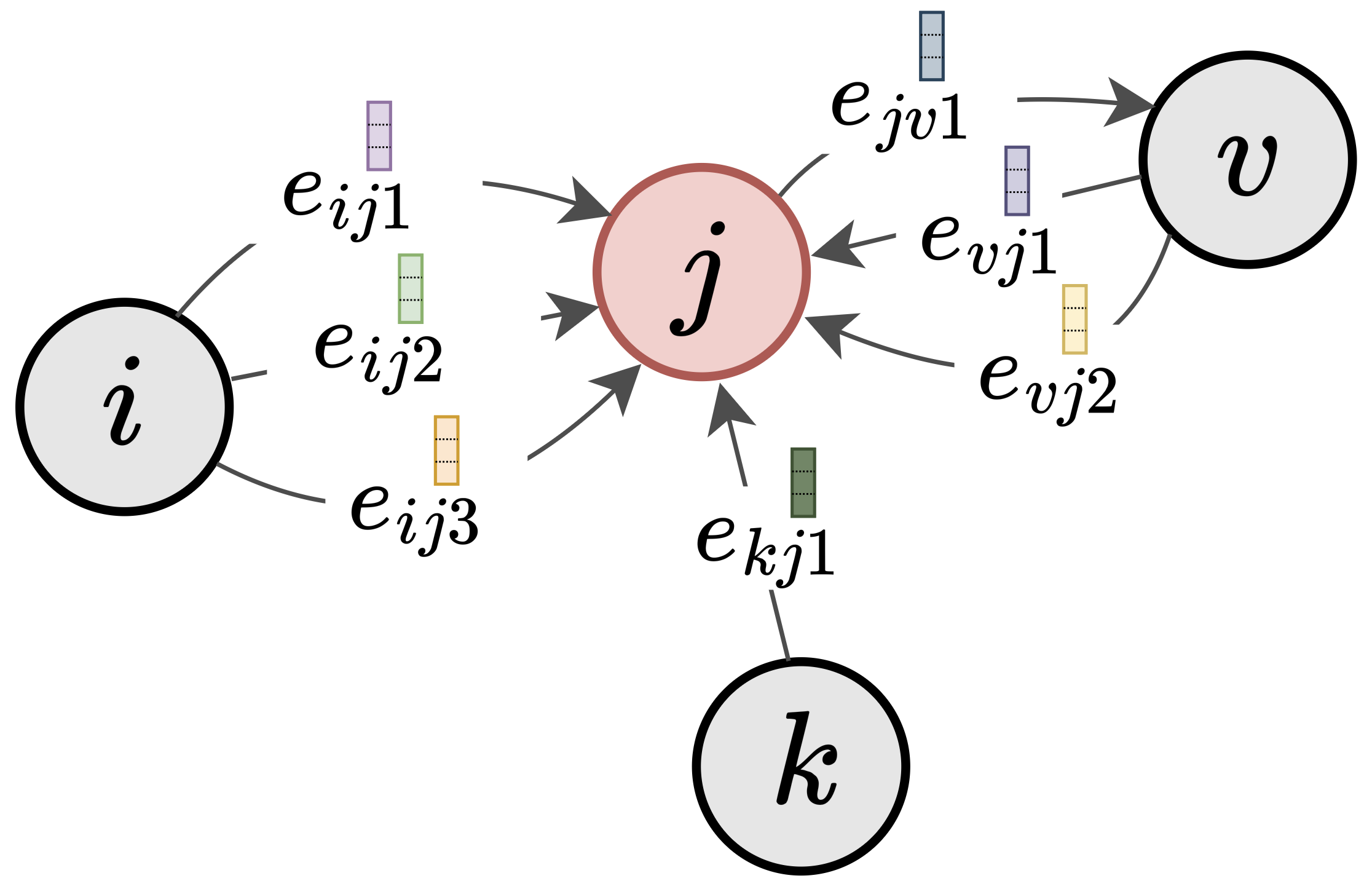
Edge-attributed multigraphs, in which multiple edges with distinct attributes connect the same pair of nodes, arise naturally in many real-world systems. In these graphs, effective learning requires preserving information from repeated interactions while distinguishing contributions from different neighbors. Existing neural network solutions for edge-attributed multigraphs remain limited: some lose information from repeated interactions, while others break permutation equivariance. To address this, we introduce \emphneighbor-aware aggregation, an operator that first combines multi-edge features for each neighbor and then aggregates across neighbors. This operator captures per-neighbor statistics that standard single-stage aggregation cannot represent. Building on this operator, we present MEGA-GNN, a model-agnostic message-passing framework for edge-attributed multigraphs. We show that MEGA-GNN is permutation equivariant and has the same asymptotic complexity as standard GNNs with edge updates. We evaluate our approach on datasets from social networks and financial transaction networks. Neighbor-aware aggregation consistently improves GNN performance and matches or surpasses state-of-the-art methods.
@article{bilgi2026mega,title={{MEGA}: Message Passing Neural Networks for Multigraphs with EdGe Attributes},author={Bilgi, H. {\c{C}}a{\u{g}}r{\i} and Atasu, Kubilay},journal={Transactions on Machine Learning Research},issn={2835-8856},year={2026},}
ICIP
Bi-Directional Tracklet Embedding for Multi-Object Tracking
H. Çağrı Bilgi, and A. Aydın Alatan
In International Conference on Image Processing 2024
The last decade has seen significant advancements in multi-object tracking, particularly with the emergence of deep learning based methods. However, many prior studies in online tracking have primarily focused on enhancing track management or extracting visual features, often leading to hybrid approaches with limited effectiveness, especially in scenarios with severe occlusions. Conversely, in offline tracking, there has been a lack of emphasis on robust motion cues. In response, this approach aims to present a novel solution for offline tracking by merging tracklets using some recent promising learning-based architectures. We leverage a jointly performing Transformer and Graph Neural Network (GNN) encoder to integrate both the individual motions of targets and their interactions in between. By enabling bi-directional information propagation between the Transformer and the GNN, proposed model allows motion modeling to depend on interactions, and conversely, interaction modeling to depend on the motion of each target. The proposed solution is an end-to-end trainable model that eliminates the requirement for any handcrafted short-term or long-term matching processes. This approach performs on par with state-of-the-art multi-object tracking algorithms, demonstrating its effectiveness and robustness.
@inproceedings{2024_metu,author={Bilgi, H. {\c{C}}a{\u{g}}r{\i} and Alatan, A. Ayd{\i}n},title={Bi-Directional Tracklet Embedding for Multi-Object Tracking},booktitle={International Conference on Image Processing},doi={10.1109/ICIP51287.2024.10648019},year={2024},}